A linear equation is an equation that describes a straight line on a graph. Explore and learn more about linear equations with concepts, definitions, facts, examples, and solutions.
A linearequation is an equation for a straight line. Let us look more closely at one example: When x is 0, y is already 1. So +1 is also needed. Here are some example values: Check for yourself that those points are part of the line above!
A linearequation is a fundamental concept in algebra that represents a straight line in coordinate geometry. It is a first-order equation, meaning the highest power of the variable is 1.
In general, there is a 5-step process to solving any linearequation. While all five steps aren’t always needed, this can serve as a guide for solving equations.
In this guide, I’ll walk you through the basics, from the definition of linearequations to some straightforward examples for 8th-grade and college students, from which you can practice independently.
In general, linearequations describe the equations of straight lines. The graph of the linearequation is always a straight line. We have linearequations in one variable and linearequations in two variables, and so on.
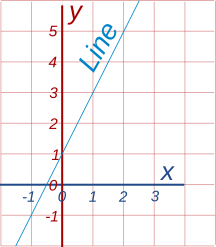 A linear equation is an equation for a straight line. Let us look more closely at one example: When x is 0, y is already 1. So +1 is also needed. Here are some example values: Check for yourself that those points are part of the line above!